
Winkler County Projected Versus Actual Release
A projected release date is a live calculation, not a completed event. TDCJ calls the field Projected Release Date and says its Classification and Records Office calculates it for a current inmate who may leave incarceration if parole does not happen sooner. Offense date, sentence facts, credit, eligibility, Board action, and time forfeiture can affect the figure. An actual release date is different. It records that the custody event occurred. A discharge date can be later still, because parole or mandatory supervision may continue after a person leaves prison.
Winkler County jail cases follow a separate path. A pretrial detainee has no sentence-based release date. The person might leave after bond, dismissal, or a court order, or remain due to a hold. A county-sentenced person may have a calculable end date, but the judgment, jail credit, and sheriff records control. No Winkler-specific published good-time schedule or weekend-release rule was found.
That distinction prevents a common mistake. A future date on TDCJ does not apply to someone who merely bonded out of the county jail. Likewise, a blank release field on a current county card does not supply a future date. Each source describes its own custody system.
Find a Winkler County Projected Release
Begin by determining whether the person is awaiting court action, serving a county sentence, or serving a TDCJ sentence. Use a TDCJ or State Identification number when available. Names can collide, so compare date of birth or age, offense, conviction county, sentence, and current location. Save the query date because calculations and statuses can change.
- Check the sheriff-linked current roster when the last known custody was the Winkler County Detention Center. Do not treat absence as proof of release.
- For a pretrial case, ask the correct court about bond and custody orders, then confirm jail processing with the Sheriff's Office.
- For a county sentence, obtain the judgment, sentence start, jail-credit entries, and any credit actually posted by the jail.
- For a Texas prison sentence, use the TDCJ Online Inmate Search with the TDCJ or SID number if known.
- Read Projected Release Date, maximum sentence information, location, and parole-review fields as separate data points.
- If the online search is insufficient or the person is no longer returned, use the TDCJ email request channel for incarceration history and date information.
- Verify an accomplished release through TDCJ history or the sheriff's booked-and-released date and disposition.
The Winkler County released-inmate search path covers the county record and court routing in greater depth. It is useful when a projected date has passed but no actual release proof appears. A detainer or transfer may mean the person left one agency without entering the community.
TDCJ Winkler County Release Fields
The state search applies only when a person entered TDCJ custody. A Winkler County arrest alone does not create a state-prison record. TDCJ results and information channels can include a TDCJ number, SID number, name, location, offenses, court and county of conviction, sentence information, parole review or eligibility, Projected Release Date, and maximum sentence or discharge details.
| Field | What it means |
|---|---|
| Projected Release Date | TDCJ's current calculated projection if parole does not occur sooner, under the applicable branch. |
| Parole eligibility date | The point when the law permits consideration, not a promise of approval or release. |
| Maximum sentence date | The calculated endpoint, distinct from an earlier parole possibility. |
| Board vote date or code | A parole-panel decision that may include later timing or conditions, not gate time. |
| Scheduled release | Operational information after review and audit; TDCJ warns that it may change. |
| Actual release date | The completed custody event shown in history or status. |
| Discharge | Completion of the sentence or supervision in that system. |
TDCJ's no-charge email information route asks for the full name and seven-digit TDCJ number. If the number is unknown, provide exact date of birth or approximate age and county of conviction. The official email-request page documents those identifying fields.
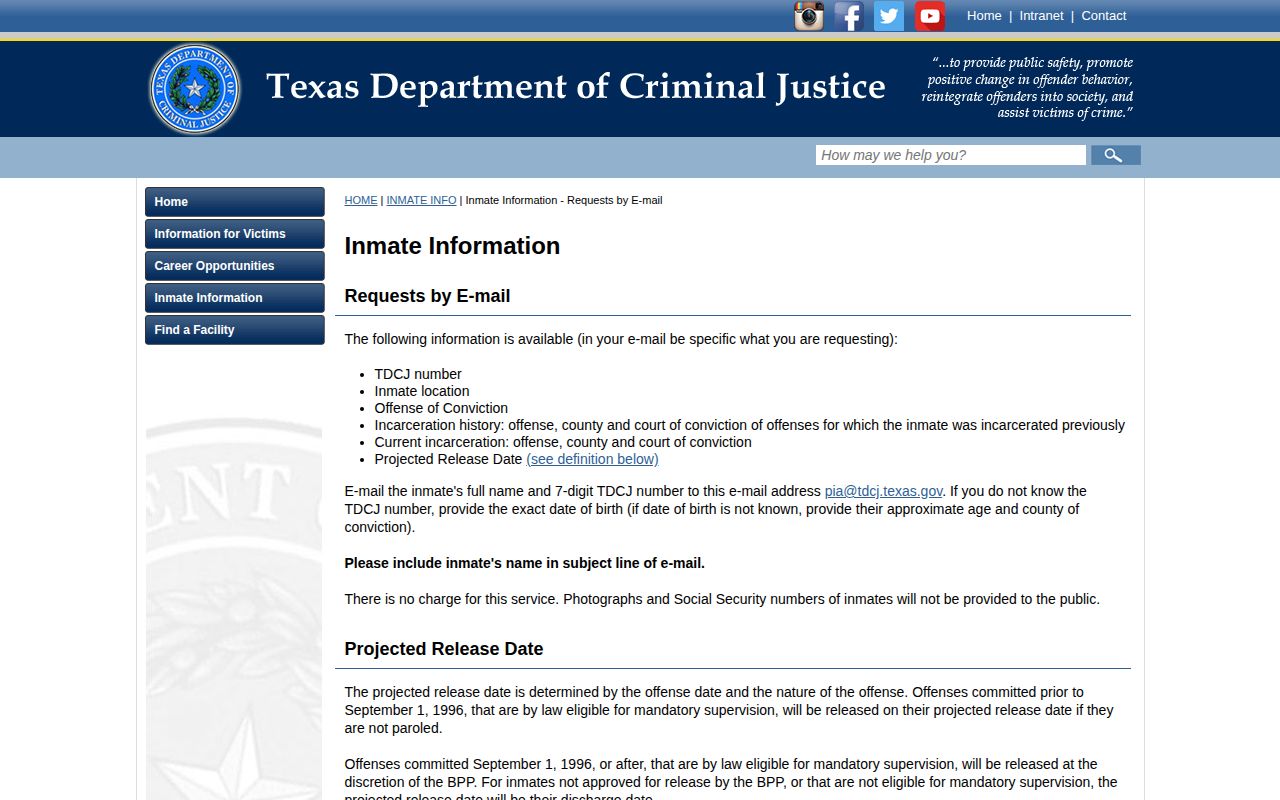
The captured TDCJ page shows the records fallback for a projected date or incarceration history when the live search is not enough.
Note: A historical TDCJ release may require email, telephone, or a Public Information Act request because the online tool focuses on current inmates.
Texas Rules Shape Winkler Release Dates
Texas does not impose a blanket rule that every inmate serves 85 percent of a sentence. Applying such a formula to a Winkler County case would be wrong. Texas uses offense-specific parole rules, mandatory-supervision statutes, calendar-time thresholds for listed offenses, sentence credit, good conduct rules, and Board decisions. The offense title and offense date matter. So do concurrent or consecutive sentences and any deadly-weapon finding.
Texas Government Code Chapter 498 governs good conduct time. Good time is a privilege. It can affect classification and eligibility calculations when the relevant release law permits, but it does not reduce the sentence imposed by the court. It may be forfeited and, where allowed, restored. Government Code Chapter 508 governs parole and mandatory supervision.
For serious offenses listed in Section 508.145(d), the general parole-eligibility measure uses actual calendar time without good-conduct time equal to half the sentence or 30 calendar years, whichever is less, subject to statutory minimums and special categories. Other subsections govern different offenses and people. Eligibility only permits review. It does not require the Board to approve release.
The official TDCJ definition separates projected-release branches.
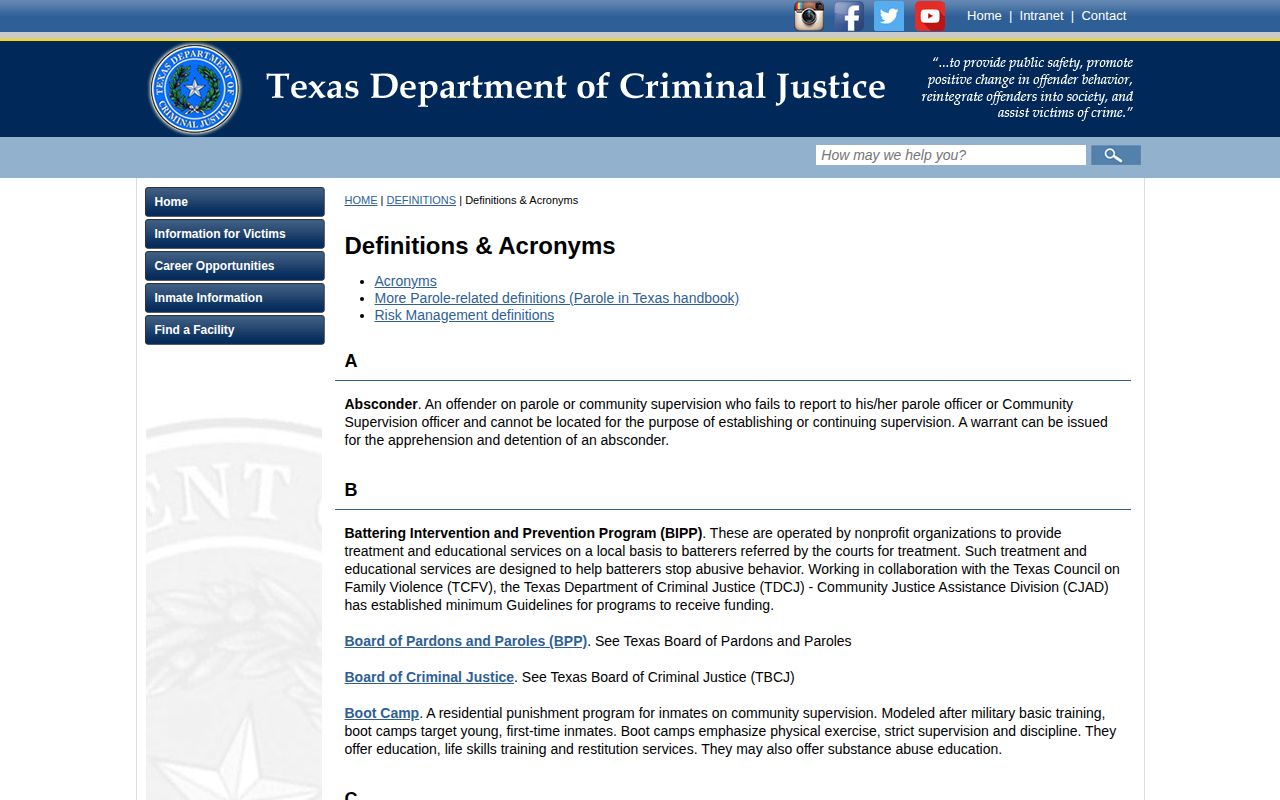
The definition capture reinforces why a single sentence-percentage calculator cannot reproduce TDCJ's individualized result.
Winkler County Release Calculation Branches
TDCJ describes three broad projected-date branches. For an eligible mandatory-supervision offense committed before September 1, 1996, flat time plus good time can reach the sentence. Flat time means actual calendar time served. For an eligible offense on or after that date, mandatory supervision is discretionary and also needs Board approval. A denial can move the projection to maximum expiration, while a later approval may recalculate it earlier.
When an offense is not eligible for mandatory supervision, the projection generally matches maximum expiration based on flat time unless parole occurs first. These are broad paths, not enough facts to calculate one person's date. The record must supply the offense date, governing category, sentence structure, credit, and Board history. Even a sound arithmetic result can be legally wrong if one input is missing.
County jail time is distinct again. The judgment and sheriff records should show the sentence, its start, jail credit, and any county good-conduct credit actually awarded. Do not copy a TDCJ projection into a Winkler County misdemeanor sentence. The county has not published a local formula that would support such an estimate.
- Flat time
- Actual calendar time credited toward confinement.
- Good conduct time
- A statutory privilege affecting classification or eligibility where the governing law permits.
- Detainer
- A notice or hold from another authority that may prevent community release.
- Parole eligibility
- The first legal point for consideration, not a release promise.
- Maximum expiration
- The calculated sentence endpoint under the controlling record.
- Discharge
- The end of the sentence or supervision, distinct from release on parole.
Why Winkler County Release Dates Change
A projected date can move after new information reaches TDCJ or the jail. The change may be an ordinary recalculation rather than an error. Record the date of each lookup and preserve the exact displayed label. If the date shifts, ask the agency that calculated it rather than using an older screenshot as current proof.
| Factor | Possible effect |
|---|---|
| Offense or offense-date correction | Can place the sentence under a different eligibility or mandatory-supervision rule. |
| Sentence structure and jail credit | Concurrent, consecutive, and credited time can change the computed endpoint. |
| Good-time accrual, loss, or restoration | Can affect an allowed calculation, while never reducing the court's sentence itself. |
| Board action | Approval, denial, rescission, or later review can alter the projected or operational path. |
| Parole approval | May permit an earlier release after conditions, audit, and processing are complete. |
| Detainer, hold, or new sentence | May prevent community release or cause transfer to another authority. |
| Records update | A corrected calculation or newly posted fact can change the public field. |
A county roster disappearance presents a different problem. It does not show that a projected date arrived. The person may have bonded out, transferred to TDCJ, moved to another county, entered federal or immigration custody, or fallen outside the current-only result scope. Request the release disposition and receiving agency.
Note: Winkler County publishes no specific weekend-release schedule, so no date should be shifted to a weekday based on a generic jail practice.
Confirm a Winkler County Release Date
For a completed county jail release, request the booking record, booked and released date and time, disposition, bond documents where public, holds, and transfer destination. A court order can explain legal authority, but it may not show when jail staff completed the exit. The sheriff's record is stronger for that physical event. If the record says transferred, follow the receiving agency instead of calling it community release.
For state custody, obtain TDCJ incarceration and release history. Determine whether the person entered parole, mandatory supervision, or full discharge. A favorable Board vote may still require a program, later month, records audit, or resolution of a detainer. The VINELink inmate search can provide participating custody alerts, while TDCJ and IVSS remain the better state-prison lifecycle sources.
Do not use VINE as a sentence calculator. It reports custody events from participating data. Likewise, do not use TDCJ to find a person who only spent time in Winkler County jail. Matching the source to the custodian turns an estimate into a reliable date record.
Keep a copy of the live result and note when it was checked. If the displayed date changes, compare the new TDCJ entry with the sentence record and Board status. For a county case, ask the sheriff or court which credit, hold, or order changed the expected Winkler County release.