
BOP Release Date Evidence
A past date carries weight only when the BOP location field supports it. The official guide states that a past release date with no facility marks departure from BOP custody, while “RELEASED” states the same boundary directly. Save both fields together. A copied date without the location can conceal whether it was still future when captured or whether the person was in transit.
BOP says locator data come from its main database and update daily. That cadence does not make the screen a court docket or a complete movement history. If the precise basis for release is needed, use BOP records and the federal judgment. If custody passed to another sovereign, use the recipient's record. Each source should prove only the event it actually maintains.
BOP Release Identity Matching
A BOP locator result should be matched through the register number whenever possible. The public result also supplies name, age, race, sex, release date, and location. Compare those fields together. A same-name result without a matching number or personal details can point to someone else, especially when the federal case arose far from the institution that later held the person.
The register number also helps connect the locator to a federal docket, BOP record request, or earlier USMS trail. Preserve its displayed format. Record the search date and copy the location wording exactly. “RELEASED,” an institution, “IN TRANSIT,” and “UNKNOWN” have different meanings, so none should be shortened to a generic custody label.
When a released result is found, read the past date beside the lack of an institution. Then consult the court record for supervised release or later orders. If another sovereign took custody, follow that agency's identifier and intake record. This method confirms the BOP event without claiming that every federal, state, local, or immigration restraint ended at the same moment.
Older records require a different route. BOP locator coverage is principally for federal inmates from 1982 onward. A pre-1982 federal prison inquiry generally goes to the National Archives. A federal pretrial release may instead belong to the court and USMS because a person can leave contract custody without a normal sentenced-prison history.
BOP Release Meaning
The Federal Bureau of Prisons manages federal sentenced custody. Its public locator gives affirmative release evidence that differs from a Winkler County roster disappearance. According to the BOP record guide, a past release date with no institution means the person was released from BOP custody on that date. A location of “RELEASED” also means the person is no longer in BOP custody.
The conclusion must keep its federal scope. BOP release does not prove that federal supervised release ended, that a different sovereign did not take custody, or that all court duties ended. “IN TRANSIT” is not release. An institution name shows a BOP location, while “UNKNOWN” indicates that the confinement term has not been determined. A future date is not a completed release.
| BOP display | Safe interpretation |
|---|---|
| RELEASED and past date | Departed BOP custody |
| Institution name | BOP location is shown |
| IN TRANSIT | Still moving within custody |
| UNKNOWN | Confinement term is not determined |
| Future release date | Expected date, not completed departure |
Search BOP Release Records
Open the BOP Inmate Locator. Search by BOP Register Number in the displayed federal format when known, or choose another supported federal identifier. A name search is also available. Compare the register number, age, race, sex, release date, and location to avoid a same-name error.
- Choose an identifier search when a federal number is known.
- Otherwise enter the person's name carefully.
- Match age and other returned identity fields.
- Read release date and location together.
- Check the federal court record for the legal outcome.
BOP says its public data are extracted from the main agency database and updated daily. Locator coverage is principally for federal inmates from 1982 forward. Earlier federal prison records generally belong with the National Archives. Record the date of the search because a location or expected date can change.
The Winkler County released inmates page explains when the county sheriff, TDCJ, ICE, or federal channels apply. Do not use BOP to look for a person who only bonded out of the Winkler County jail.
BOP Locator Release Fields
BOP results show name, register number, age, race, sex, release date, and location. The release date and location must be read as a pair. A past date with no facility or a released location supports completed BOP departure. The locator does not provide the full judgment, all transport details, the terms of supervised release, or proof that no other government assumed custody.
The official BOP explanation is the key to interpreting the screen. It also warns about people in transit and those whose location or term is unresolved. These qualifications prevent the common mistake of equating any listed date with actual release. If a federal court order, BOP display, and another agency record seem inconsistent, compare the event dates and ask the originating agency about its own record.
The BOP record guide shows how released entries and locator limits are presented.
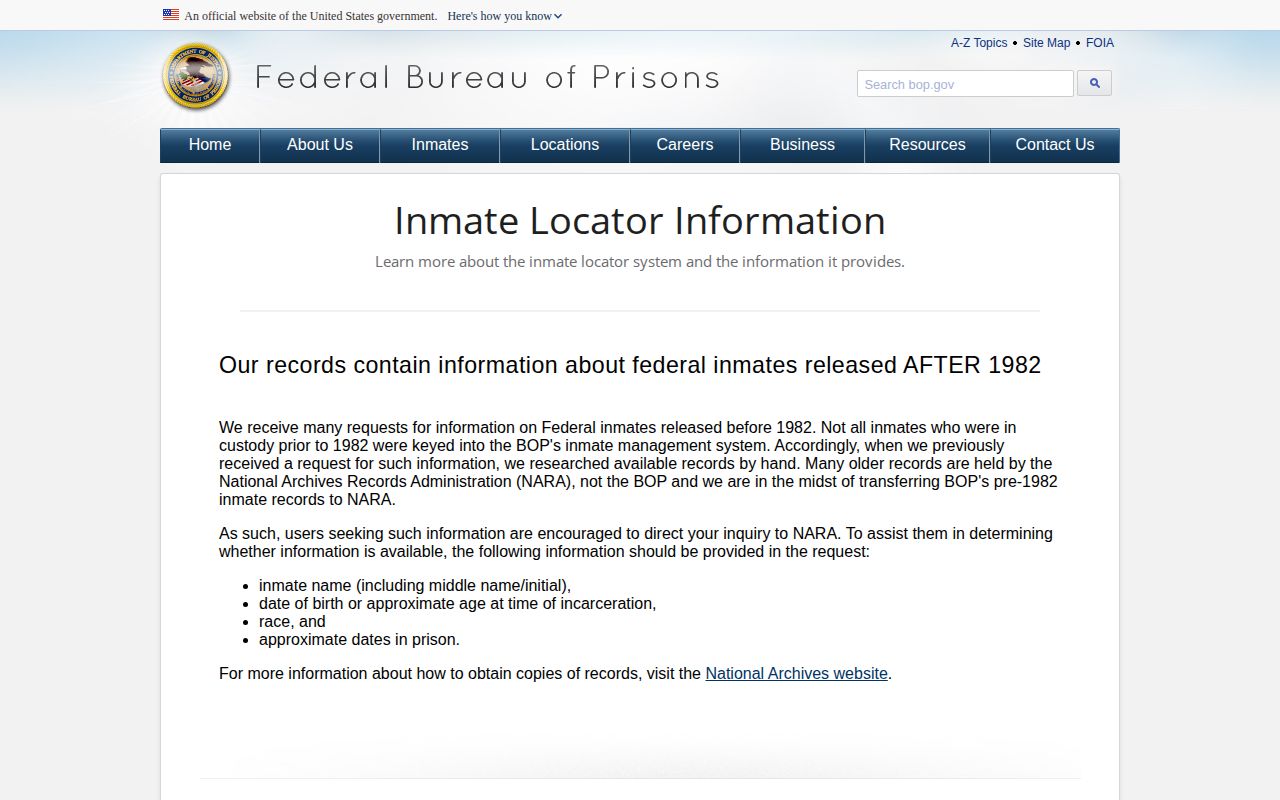
The captured official page supports the narrow finding that BOP status confirms departure from BOP, not the end of supervision or custody elsewhere.
Request BOP Release Records
Use BOP FOIA when the locator lacks needed detail. Identify the person, register number, institution if known, date range, and the exact record sought. Ask for an existing release or incarceration record rather than a new explanation. Privacy Act and law-enforcement exemptions can limit disclosure about another person, and identity proof or authorization such as DOJ-361 may be required.
BOP FOIA/Privacy Act Section
Office of General Counsel, Room 924
Federal Bureau of Prisons
320 First Street NW
Washington, DC 20534
Email: BOP-OGC-EFOIA-S@BOP.GOV
Phone: 202-616-7750
FOIA provides a 20-working-day determination framework, but BOP warns that practical estimates can be about 60 days for many simple requests and as long as nine months for many complex requests. Those are agency estimates, not a promise for one request. The scope, record location, review needs, and exemptions can affect timing.
A narrow request can seek incarceration history, actual release date, release location, or transfer information that is publicly releasable. The locator itself may be enough for a basic BOP-custody confirmation, while the federal docket may better explain the sentence and post-release terms.
BOP and USMS Releases
BOP does not cover every federal pretrial custody event. The U.S. Marshals Service takes custody of people arrested federally and may house them in state, local, or private contract facilities. A federal court may release or remand a defendant after a hearing. After conviction, USMS can transport the person to a designated BOP institution.
There is no public USMS name-based released-person locator comparable to BOP. For pretrial release, use the federal docket and release order, then seek the relevant USMS or contract-jail record if more detail is needed. A person may leave a local jail under USMS transport without appearing as a normal released federal prisoner in BOP history.
BOP Versus Winkler Release
No federal prison was identified in Winkler County. Geography still does not decide which record applies. A local federal arrest may lead to USMS contract custody outside the county, and a federal sentence may lead to a distant BOP facility. Conversely, a person released on a Texas or local charge may never have a BOP record.
| Custody event | Primary proof |
|---|---|
| Winkler jail bond release | Sheriff booking and release record |
| Federal pretrial release | Federal court order and USMS trail |
| Federal sentenced release | BOP locator and records |
| State-prison release | TDCJ history |
| ICE detention release | ICE locator or ERO records |
A county transfer to USMS or another federal agency is not release into the community. It proves only that the county booking ended and federal custody began or continued. Use the receiving agency named in the record.
Federal Release Follow-Up
After a BOP released result, consult the federal court docket when supervised release, a later order, or the case outcome matters. Supervised release is court-ordered monitoring after prison and differs from old-style federal parole. The locator's released label does not describe all terms or report whether another jurisdiction has a hold.
Match every result by register number and personal details. Preserve the exact federal status and search date. Do not convert “released from BOP custody” into a broader claim. When the person appears to have moved to ICE, state, or local custody, use that system's official record next.
Note: A past BOP release date is affirmative federal evidence, but its meaning stops at the BOP custody boundary.